
Uber burned through its entire 2026 AI token budget by April. Its president called it a “head-exploding moment.” Where was the CFO? Where was the monthly expense tracking?
Tokenmaxxing: When the Metric Becomes the Goal
The Big Tech companies have been factoring A.I. into performance reviews with some having internal leaderboards, ranking employees by AI prompt volume. This is turning into a masterclass in Goodhart’s Law: when a measure becomes a target, it ceases to be a good measure.
Is Prompting More = Producing More?
The TOKENMAXXING Paradox.
Organisations that adopted AI most aggressively assumed that the volume of AI interaction would correlate with output quality and business value. It doesn’t.
So, what is effective AI use? It certainly is not about sending the most prompts. Rather, it’s about structuring the right prompt, at the right stage, for a task where AI actually has an edge. That requires judgment. Judgment is what any professional brings to the table.
The irony is that lazy AI use is also the most expensive AI use. Vague prompts generate verbose, off-target outputs that require correction. Correction requires more prompts. More prompts burn more tokens. When an employee doesn’t know what they want from AI and just keeps prompting until something looks acceptable, they create a double spend of company resources (tokens and employee time).
Employee Profitability in the AI Era
Here’s the finance question that very few companies are actually asking: What is the fully-loaded cost of an AI-enabled employee, and what is the measurable output?
Pre-AI, employee profitability was already a difficult calculation, especially for the non-billable staff and support roles. Go to measure - Gross salary, employer social contributions, benefits, equipment, and office overhead. Every business has its own framework to measure employee return.
Now add AI spend.
UBER’s engineering team reportedly burned through its annual token budget within the first four months of the year. Suddenly, you are looking at meaningful per-engineer AI costs sitting alongside an already significant salary base. If that cost isn’t tied to a measurable output, shipped features, customer-facing improvements, support ticket resolutions, or revenue impact. Then you’ve created a new overhead category with no accountability structure.
The uncomfortable truth: some percentage of that token spend is replacing human thinking that was already being paid for. The employee who used to spend two hours designing an architecture is now spending ten minutes generating one and four hours iterating on outputs that aren’t quite right.
The company pays twice: the salary and the tokens. And gets ???
How to Actually Budget AI Spend
CFOs need to stop treating AI as a software cost and start treating it as a variable operational cost tied to outputs and not inputs.
What is a good workable framework:
1. Output-based allocation:
Assign AI budgets at the team or project level, not the individual level. The team working on a revenue-generating feature gets a token budget equivalent to the expected value of that feature. Ditch the leaderboard logic. It breaks the dynamics and gives wrong incentives. Stop rewarding consumption, start rewarding quality contributions.
Nobody learns to budget without hitting a wall first. Give a kid €50 a week and eventually they’ll spend it all by Wednesday. No allowance until next week. Lesson learned. Build that friction into your AI spend.
2. Track cost per output:
Especially when it comes to API usage and paying per token, we need to track the value of the output. The principle is simple:
- What did this AI spend produce?
- Lines of code shipped?
- Customer issues resolved?
- Marketing content published, and what did it convert at?
Without output measurement, you have no ROI visibility, which is precisely where businesses desperate to ride the AI craze are ending up.
Deep pockets don't excuse shallow thinking.
On top of that GPU costs are continuously increasing, and while companies are signing long-term contracts with AI solutions, token prices are quietly increasing. We need to learn how to use AI smart rather than impulsively. We do not have the capacity, GPU power, or data centres to maintain the impulsive consumption of AI. Now is the time to create effective frameworks around this.
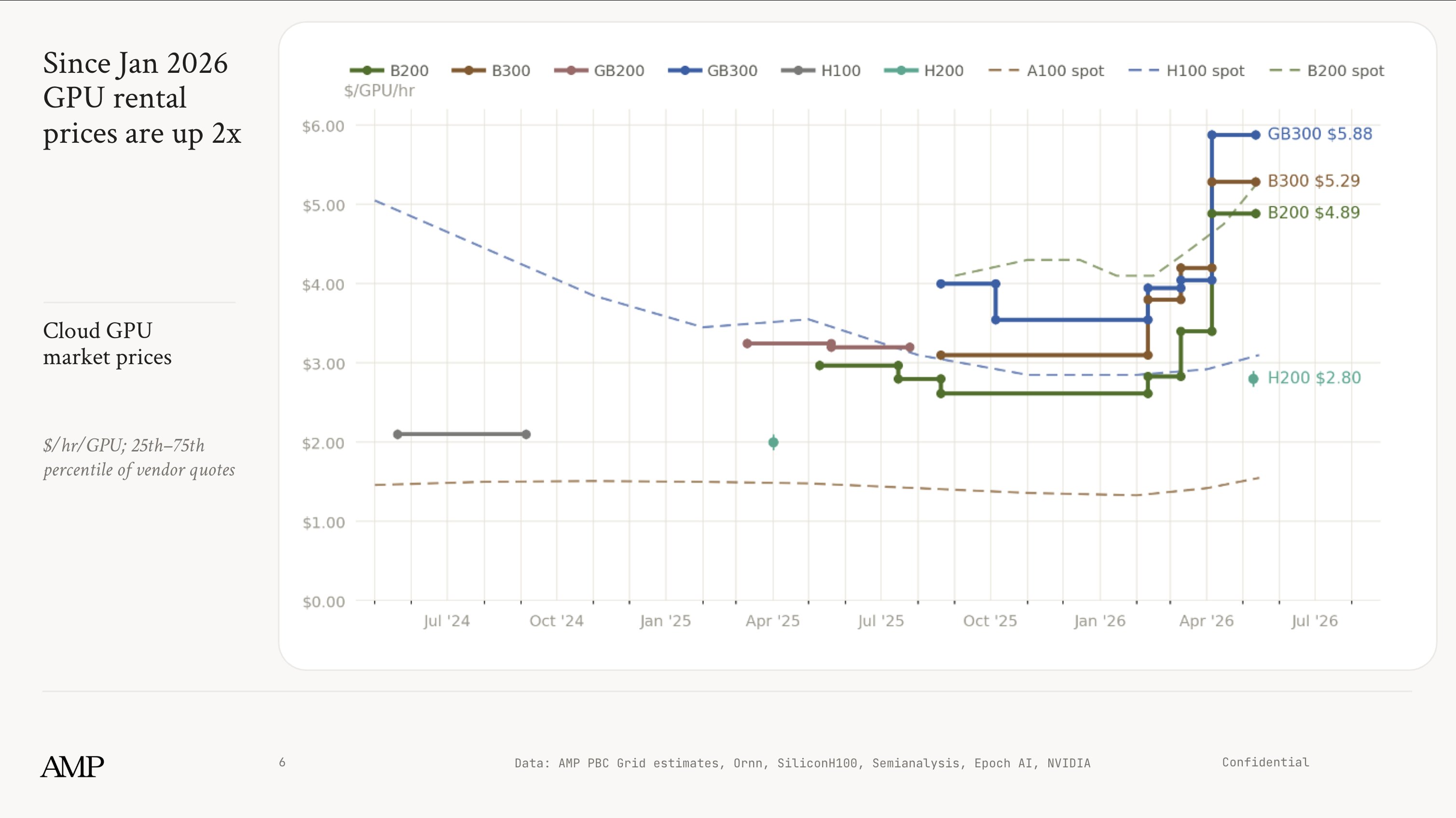 GPU rental costs have doubled since January 2026. Source: AMP PBC Grid estimates.
3. Efficiency benchmarks:
Not all token spend is equal. A well-structured prompt that produces a usable output in one call is worth ten poorly structured prompts that converge on the same result after loops. That’s where leadership should step in. Enable your team with the right guidelines and framework to use AI smart and not just impulsively. You hire talent, enable that talent, and make sure they stay active thinkers. Measure team performance on token efficiency relative to output, not on raw usage volume. This is a cultural shift as much as a financial one.
The Harder Question
Here is the corporate AI narrative that many have been reluctant to admit. AI usage does not magically make employees more valuable. In some cases, it makes the value of the employee harder to isolate. Next thing you know, your employees are becoming an asset you need to depreciate. The reliance on AI reduces mental performance and laziness decrease performance and knowledge. When 70% of committed code comes from AI tools, what exactly is the engineer contributing? Taste? Judgment? Verification? Those things matter enormously, but they’re not being measured, and they’re not showing up in any leaderboard.
The companies that figure out how to measure judgment and AI efficiency together, not just AI volume, will build the actual competitive advantage. Everyone else is just paying for a very expensive experiment with no control group.
If you want to know what your AI spend is actually returning, start by building the right measurement framework. I’ve put together a model that does exactly that - fully-loaded employee cost, token spend by team, and output ROI in one view. If that’s useful,